End-to-end, zero-knowledge and on-device aren't the same.
Last time the question was who kept a copy of your key. This is the part where you can carry that question onto any privacy page and work out which of its promises is actually answering it.
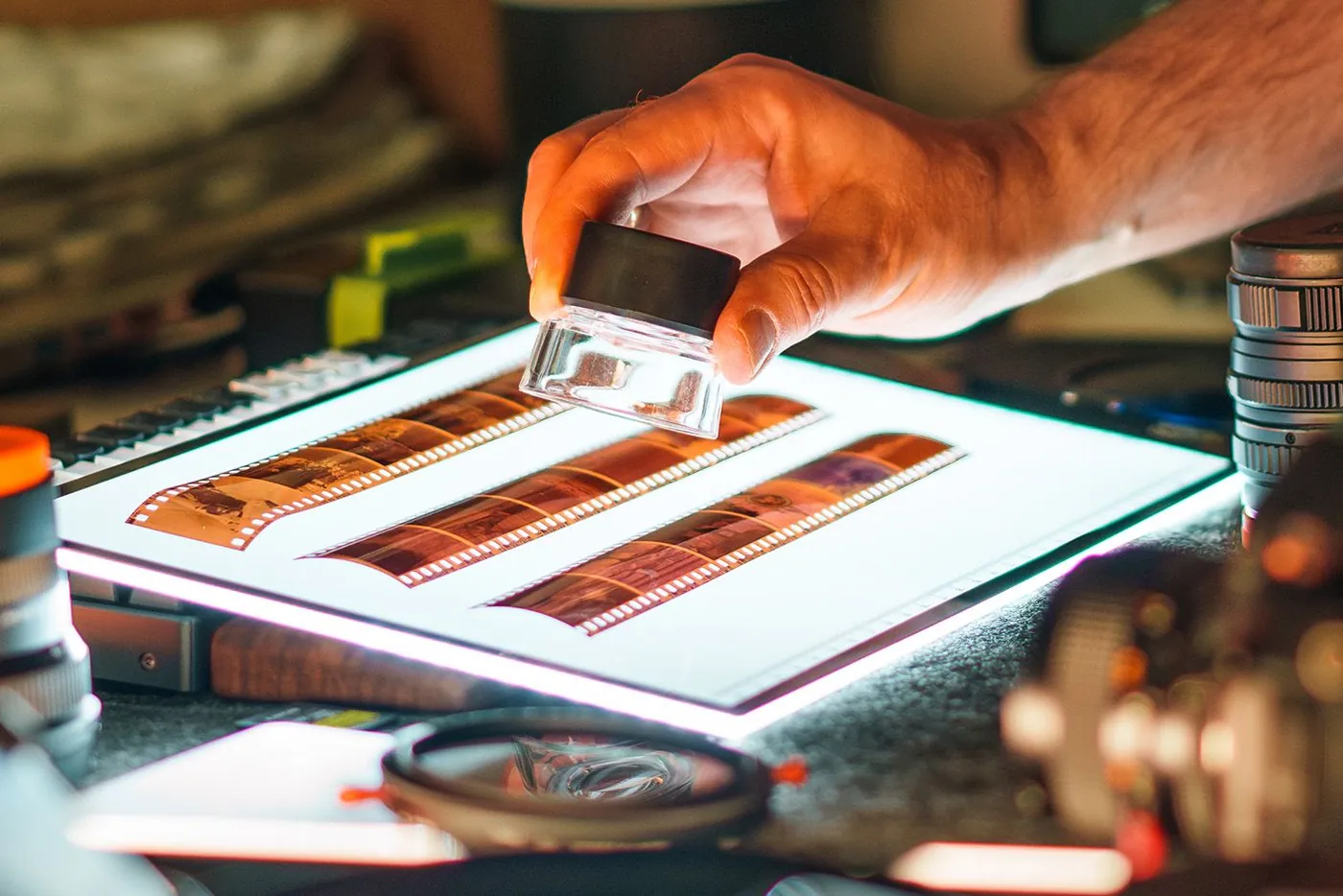
Every high street used to have a shop that developed film, I know, I used to be responsible for 50 of them, and the good ones put a sign in the window saying ON THE PREMISES. It mattered, because the place three doors down posted everything off to a lab in Basingstoke and handed it back a week on Thursday.
That sign kept coming to mind while I was writing the comparison pages, which meant reading privacy policies for weeks. Three phrases turn up over and over. End-to-end encrypted, on-device and zero-knowledge.
They get used as though they were three ways of saying one thing, but let's be clear about it, they're three claims about three different parts of the shop.
On the premises
The sign meant something real. Your negatives didn't go in a van, they didn't spend a night in a tray in another county with a hundred other people's, and whatever happened to them, happened behind a door you could see from where you stood.
That is what on-device means, and it is worth having for the same reasons.
It is also, and this is where the sign is no help at all, a statement about one room. It tells you where the developing happened, but it tells you nothing about what the staff did next.
Transcription that runs on your phone rather than on somebody's server is a real improvement and I would take it every time. The model ran on the handset, great. Did the text it produced stay on the handset or did it sync somewhere 3 seconds later? The sign gives no indication because the sign was never about that.
The journey home
Then there's the envelope, for those too young to remember, it was the paper one they hand you at the counter with the prints inside and the negatives in a sleeve.
End-to-end encryption is the envelope. Sealed when it leaves the shop, still sealed when you get home, and nobody on the bus knows what you photographed. Everything in between, the Wi-Fi in the coffee shop, your Internet provider, the company's own servers, sees a sealed envelope and nothing else.
Also real, also worth having.
It also stops working the moment you open it, which sounds too obvious to be worth saying, and it is obvious. It's still the part people rarely get. End-to-end protects the journey. It has nothing whatsoever to do with either end of that journey.
Who counts as an end
The phrase promises that the two ends can read it. What it never says is who the ends are, that gets decided by the company rather than by you.
An end is anywhere your writing sits as words instead of noise. Your phone is one, the other person's phone is another. A backup made somewhere convenient is a third, if it is made in readable form, and search that runs on a server, so it can be quick, is a fourth.
Every one of those is a feature somebody asked for, and I would be wary of a company that pretended otherwise.
None of them break the end-to-end promise either, that's what makes the phrase so slippery. The envelope really was sealed the whole way home and it arrived sealed until someone opened it. Wherever the envelope ends up, at some point, it gets opened.
The shoebox under the counter
A shop can develop on the premises, and seal your envelope properly, and still keep a shoebox under the counter with a second set of everybody's prints in it. I've seen it done, more than once.
Nothing in the first two claims prevents the third. That is the entire problem and it's why the two phrases everyone recognises are the two actually answering the smaller questions.
Zero-knowledge is the claim that there is no shoebox, not that the shop promises not to look in it and certainly not that the shop has a policy about who can look in, along with how often the policy is reviewed. The reality is that the shop can't reproduce your prints, because it never kept any, and when somebody walks in with a warrant and asks to see them, the answer is always the same, nothing to see here. Part two was the long version of why, and the short version is that a company can only hand back what it can already read.
It is the hardest of the three to say and mean, which is why you meet it the least. Claiming it commits a company to a list of things it then can't do, and most of those things are things customers ask for, loudly, in support tickets.
Three questions, and the third one is blunt
None of this makes the phrases dishonest. All three can be true at once, and where they are, that is a shop worth trusting and frequenting.
What I do with a privacy page now is treat each phrase as a sentence somebody abandoned halfway through.
On-device up to which step? The developing, or all of it?
End-to-end between which two points and how many further points has the company quietly afforded itself since it wrote that sentence?
Then the one that settles it. Is there a shoebox?
You can usually find the answers somewhere on the site. What you will rarely find is an answer in the same paragraph as the phrase, and after enough of these you start reading that as an answer all by itself.
Where I sit, and the bit I would rather not write
There is no Catchlight server, so end-to-end is an odd description to reach for, as there is no second end. Your writing is encrypted on the phone, the encrypted files go into a folder you already own, only if you decide they need to, and it's your iCloud Drive or your Dropbox. None of it passes through anything of mine, because there is nothing of mine in the way, nor will there ever be.
Zero-knowledge is the one I would stand tall on. The 12 words are made on your phone the first time you open Catchlight, and they never leave. That means, even if I did hold your encrypted data, which I wouldn't, there is nothing at my end I could use to decrypt it. No shoebox, and not as a matter of policy, as a matter of it not existing.
On-device is true in the flat sense. Every feature works with the network off. Aeroplane mode changes nothing.
Now the bit I would rather not write. Your cloud provider still holds those encrypted files, they can't read them and that's the whole design. What they can still see is the shape of the folder. How many files are in it, how big each one is, and when their own system last touched one.
Catchlight's own index is encrypted, so the folder doesn't publish a running log of when you edited each Take or what you deleted. That much I could close off and did. The provider's view of its own storage I can't, because it isn't mine to close, and no amount of encryption at my end makes a file stop being a file.
Putting the files in a folder you control was the trade-off I picked, because the alternative was a server of mine holding them. Between those two I would rather it was your chosen provider than me, and if you think about it, so would you.
There is a second thing while I'm here. iOS can index things for Spotlight and Siri, and an index sitting on your own phone is still on-device by any reading of the term. Catchlight keeps all your Takes' text out of that index, so the words you write are never handed to it. That is a shoebox I could have kept and it would be in the one room where "on-device" would have covered me. That said, I would rather tell you it's empty than let the phrase do that work on my behalf.
If you want to go further
The term on its own gets a piece to itself in what zero-knowledge actually means, the glossary keeps the definitions in one place, and the comparison pages line the apps up on exactly these points. The two earlier parts are what encryption actually is and who holds the key. For one company answering all three questions in public and then being tested on the answers, there is can Apple read your notes and the week the UK lost Advanced Data Protection.
ON THE PREMISES was a really good sign and it was never a lie. It only answered the smallest of the three questions, in the biggest letters in the window.
Join the list and we'll tell you the day Catchlight is ready, with extra time on the free trial.
Early joiners get 30 days free, instead of 14, when we launch, and that's all we'll email you about.